

Scale degrees and tonal functions explain why some notes and chords feel settled, others create motion, and a dominant chord can make a return sound inevitable. This practical piano guide uses C major to show how degrees work, how I–IV–V–I creates direction, how diatonic chords are built and how to hear the idea at the keyboard.
What is a scale degree?
A scale degree is simply a note’s position within a scale. In C major, the notes C, D, E, F, G, A and B are numbered I, II, III, IV, V, VI and VII.
The number does not replace the note name. It tells you how that note behaves within a particular key. C is degree I in C major; it is also the tonic, the note that gives the key its centre of gravity.
End a short phrase on C and it usually sounds complete. Stop on G instead and the ear often expects more. This has nothing to do with a white key looking more final than a black one, or with where the key sits on the piano. It comes from the note’s relationship to the tonic.
For a refresher on the notes that make up a key, see our guide to major scales on the piano.
The seven degrees in C major, from the keyboard
| Degree | Note in C major | Common name | What to listen for |
|---|---|---|---|
| I | C | Tonic | Rest, centre |
| II | D | Supertonic | Movement, preparation |
| III | E | Mediant | The colour of the key |
| IV | F | Subdominant | Moving away from the centre |
| V | G | Dominant | Tension and return to C |
| VI | A | Submediant | A colour close to the relative minor |
| VII | B | Leading tone | An upward pull towards C |
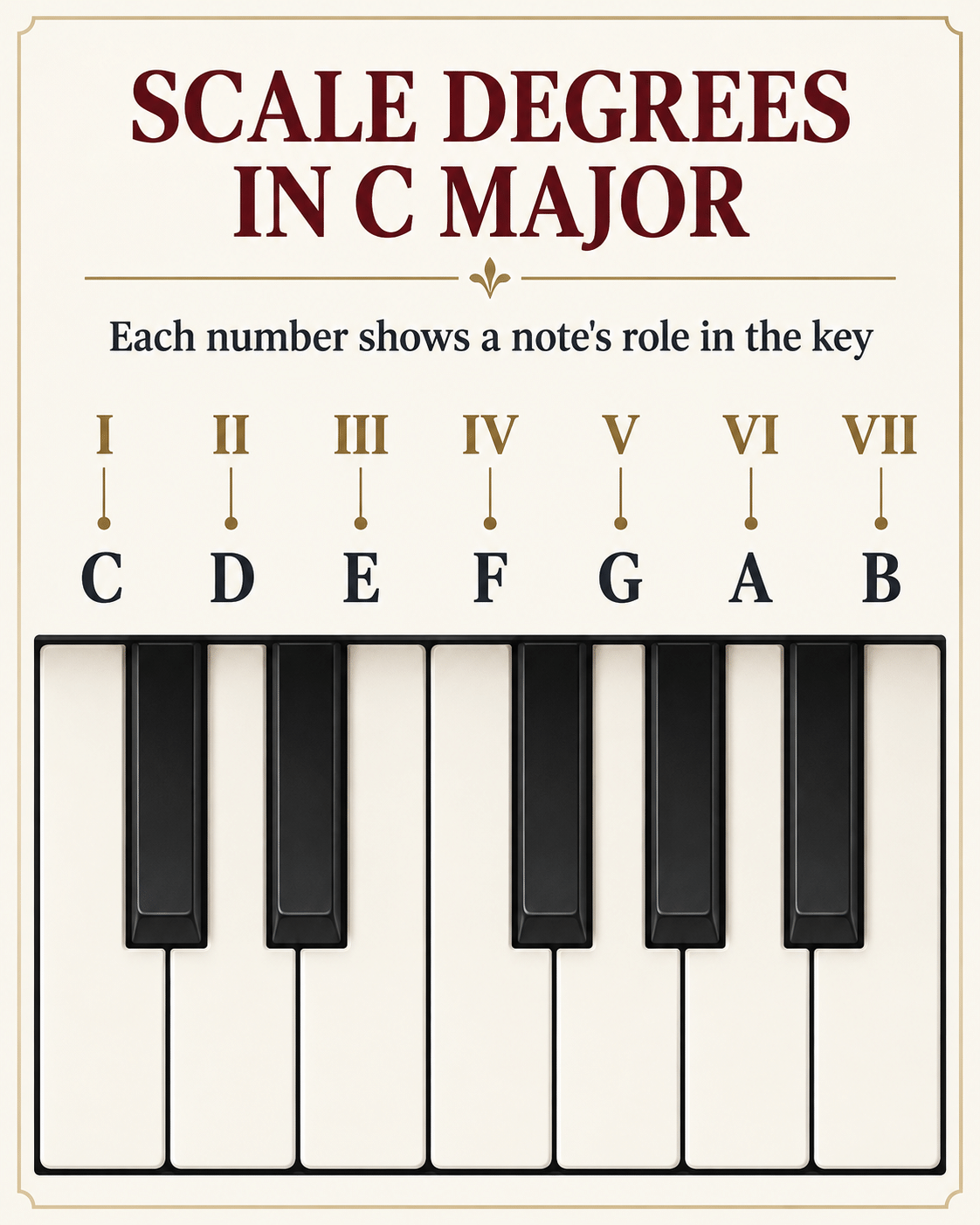
These names are useful reference points, not a list to recite before you can make music. At the piano, start by noticing I, IV and V. They form a compact map of departure, movement, tension and return.
Tonic, subdominant and dominant: the basic conversation
Tonal functions bring together degrees that play a similar role. At a practical level, three families are enough to begin:
- Tonic function: I is the stable point. VI, and sometimes III, can share part of that settled character.
- Subdominant function: IV moves away from the tonic. II often prepares the same area.
- Dominant function: V creates the pressure that leads back to I. VII has a related role because it contains the leading tone.
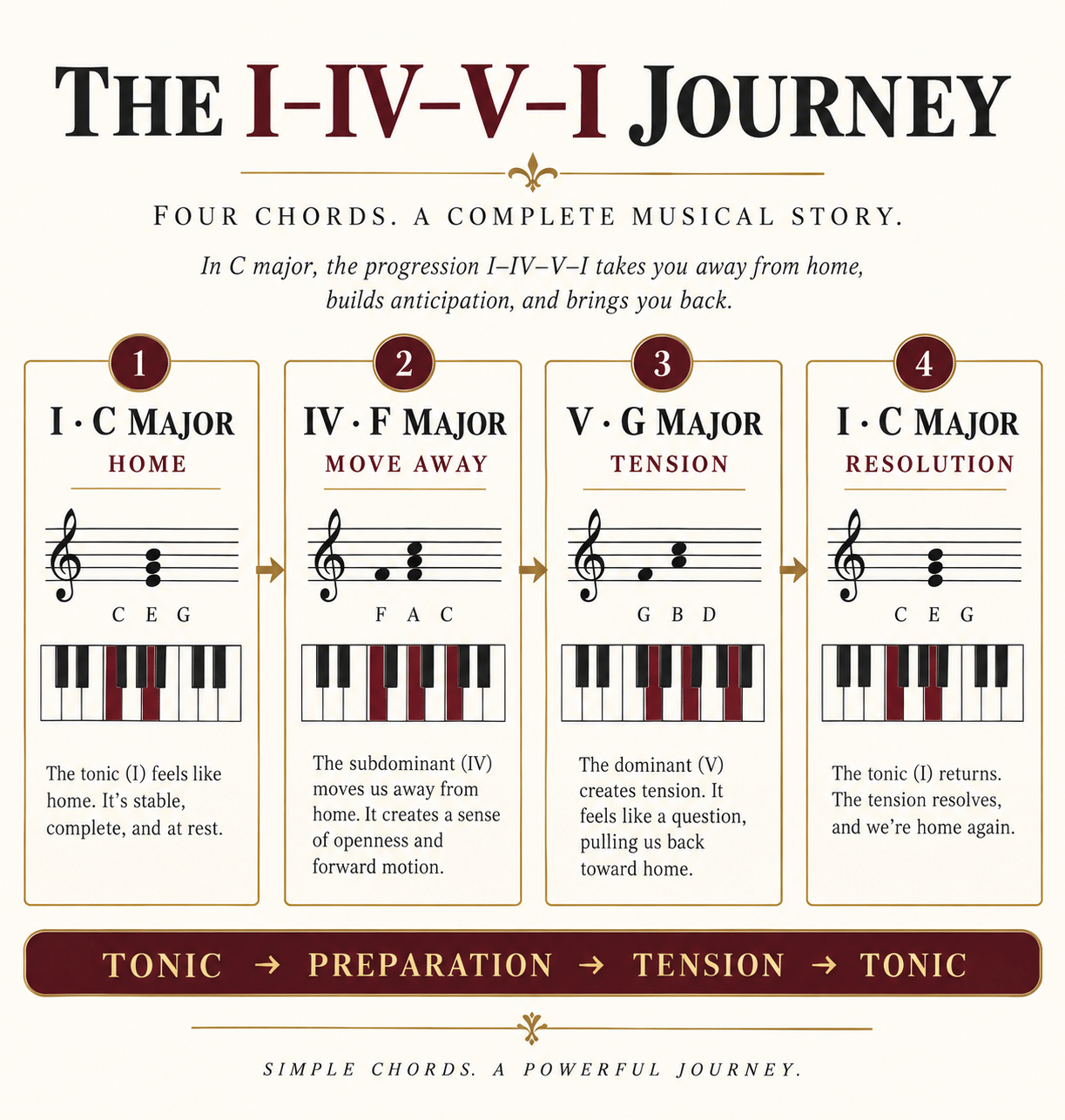
Try this without a score. Play C major, then F major, G major and C major again. In Roman numerals, that is I–IV–V–I.
The first chord establishes the key. F changes the view; G leaves the phrase open; C makes it settle. The sequence does not explain every musical event, but it gives you a reliable first way to listen to harmony.
A useful pattern: tonic → preparation → tension → tonic. In C major: C → F → G → C.
Play the progression first with the sustain pedal, listening to the change of colour from one chord to the next. Then repeat it without the pedal and listen for the individual voices. The contrast is instructive: one version reveals the overall sound, the other makes the movement inside the chords clearer.
Why degree V leads back to I
The dominant is not magic, and a G chord does not have to resolve to C every time it appears. In C major, however, G major contains B. B sits a semitone below C and tends to rise towards it, so it is called the leading tone.
That small B–C movement is one of the clearest signals of resolution in tonal music. Play B followed by C several times. Then play G–B–D and resolve it to C–E–G. Listen to the small movements between the voices, not only to the change of chord name.
Musical intervals help explain why this works: the leading tone is a minor second below the tonic. For a more detailed theoretical account, Open Music Theory explains the basics of functional harmony.
From degrees to diatonic chords
Every degree can become a chord if you stack thirds using only notes from the scale. In C major, the diatonic triads are:
I C major · ii D minor · iii E minor · IV F major · V G major · vi A minor · vii° B diminished.
Upper-case numerals indicate major triads; lower-case numerals indicate minor triads. The diminished symbol marks the unstable seventh-degree chord.
A sequence such as C–G–A minor–F is I–V–vi–IV. Move that same sequence to G major and it becomes G–D–E minor–C. The chord names change, but the relationships between the degrees remain.
Our guide to building piano chords can help you construct these triads from their roots.
A ten-minute exercise that connects ear and hands
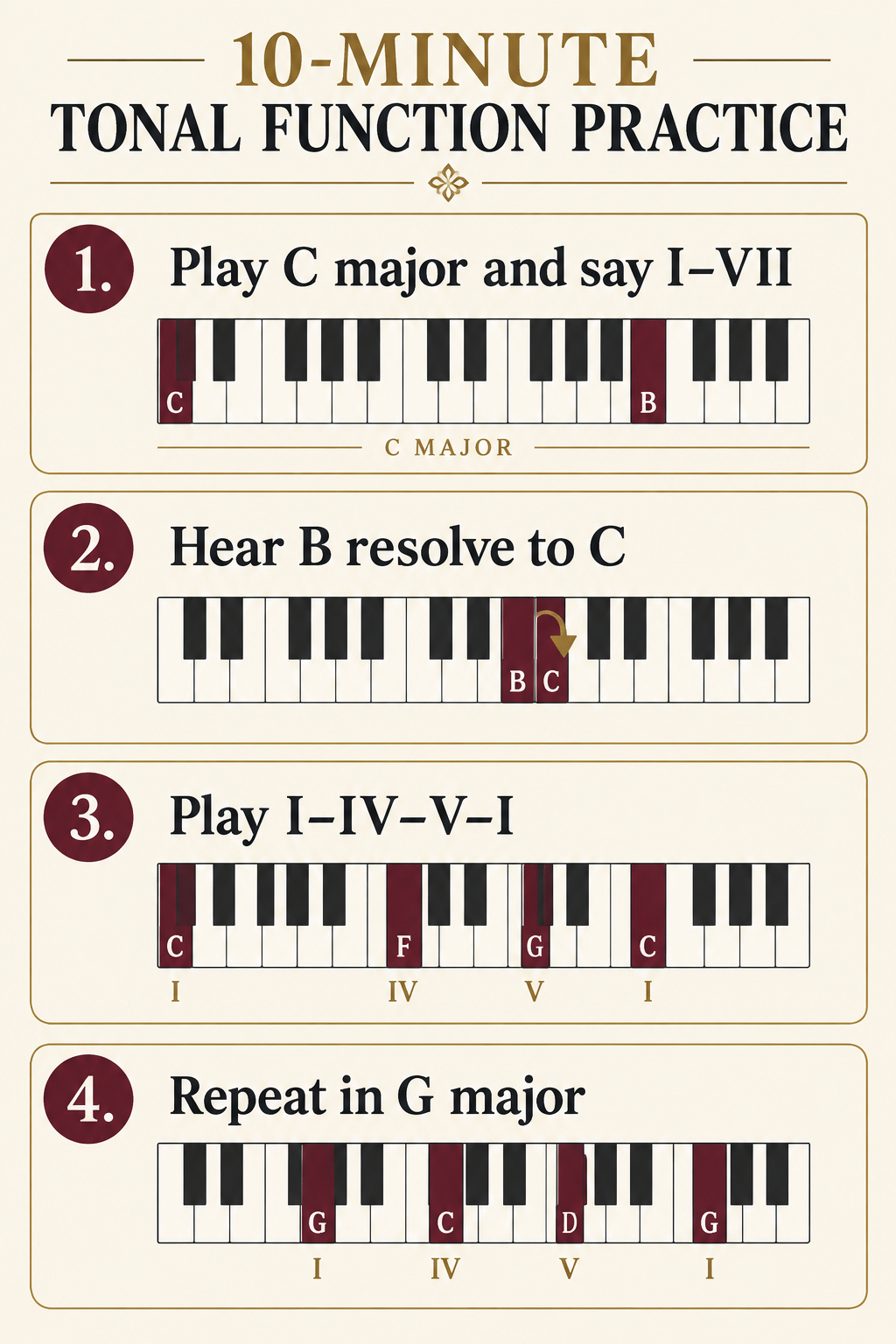
- Play C major slowly and say the degrees aloud: I, II, III and so on. Accuracy matters more than speed.
- Alternate C and G. If you can, sing B immediately before returning to C.
- Play I, IV, V and I in the left hand in comfortable positions. Add notes from the scale in the right hand.
- Improvise four bars. Begin and end on C, include F, and place G just before the final C.
- Repeat the same route in G major. Write the degrees, not only the chord names, and notice what changes under your hands.
That final step matters. Moving the pattern to a new key shows that you understand the relationship rather than merely remembering a visual shape in C major. The circle of fifths is a practical guide for choosing the next key and locating its accidentals.
Common mistakes
Thinking that a degree is a fixed note
G is degree V in C major, but degree I in G major. A degree always takes its meaning from the tonic of the moment.
Giving every chord the same weight
All seven chords belong to the key, but they do not have the same effect. I, IV and V organise much of basic tonal harmony; ii, vi and vii° offer colour, preparation and alternative routes.
Memorising progressions without hearing their direction
Roman numerals are useful, but they are not the music itself. Play the progression and ask where it settles, where it moves away and where it starts to expect a return.
Common questions
Do scale degrees work the same way in minor keys?
The principle is the same, although natural, harmonic and melodic minor change some notes, chords and functions. You can revisit the variations in our guide to minor scales on the piano.
Do I need to learn Roman numerals?
Yes, gradually. Start with I, IV and V, then add ii and vi. They appear frequently in songs, accompaniments and classical cadences.
Does this help with classical pieces?
It gives you more context while you read. Recognising a dominant before a cadence can help you anticipate a phrase, even though real pieces may use inversions, modulations and richer harmonic devices.
A thought that changes how you practise
Scale degrees do not replace the ear; they give it vocabulary. Once you hear a phrase settle on I, or hear V preparing a return, harmony stops being a set of labels and becomes a direction you can recognise and play.
These relationships need time, repetition and an instrument that responds clearly to touch and dynamics. If you are practising at home, explore our range of digital pianos or speak with the Royal Pianos team.
Editorial note. This article has been prepared and reviewed by the Royal Pianos Marketing Team as part of our educational series on music theory applied to piano.
Transparency about the use of Artificial Intelligence. The images identified in this article were generated with Artificial Intelligence for illustrative purposes only. They do not represent real instrument models, finishes, configurations or situations. The editorial content has been prepared and reviewed by the Royal Pianos Marketing Team.










Leave a Reply
Want to join the discussion?Feel free to contribute!