
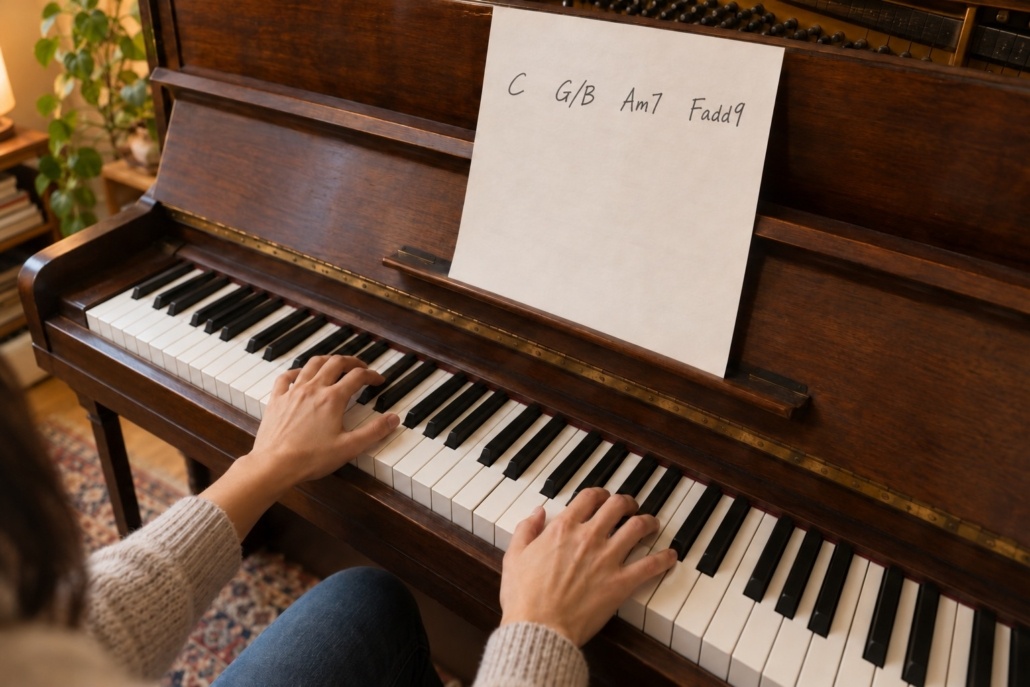
Reading piano chord symbols means turning signs such as C, Am7 and G/B into notes you can play and choices you can make about accompaniment. This guide explains what each letter, number and sign tells you, how to divide the notes between your hands, and what the symbols leave for you to decide.
Which note does each letter name?
On many song sheets, letters sit above the melody or lyrics. These are chord symbols. The first letter names the chord’s root: the note from which its basic structure is built.
| Letter | C | D | E | F | G | A | B |
|---|---|---|---|---|---|---|---|
| Note name | C | D | E | F | G | A | B |
In English notation, B means B natural. For B-flat, the symbol is B♭ or Bb. A sharp raises the root by one semitone: F♯ is F-sharp. A flat lowers it: E♭ is E-flat. Read that alteration before deciding whether the chord is major or minor.
If you need to work out the notes of a basic chord, our guide to how piano chords are built explains roots, thirds and fifths at the keyboard.
In what order should you read a chord symbol?
Read from left to right: root, chord quality, added or altered notes, then any bass note after a slash. The symbol does not prescribe a single hand shape. It names a harmony; you choose a playable arrangement.
C is C major: C–E–G. A lowercase m changes the third: Cm is C–E♭–G. A letter on its own usually denotes a major chord, but the capital letter merely identifies the root. Thus Am is A minor, A–C–E.
Some sheets use min or a minus sign for minor, and dim or ° for diminished. It helps to recognise these variants, though letters, m, sevenths and slash bass notes will take you through many beginner song sheets. Check the notation key when an edition uses unfamiliar symbols.
Open Music Theory’s explanation of triads and chord symbols sets out these conventions, including how a different bass note is indicated.
C7, Cmaj7 and Cm7: which notes change?
The 7 in C7 does not mean “play the seventh note of the C major scale”. C7 adds B♭ to a major triad: C–E–G–B♭. Cmaj7 keeps the major triad but uses B natural. Cm7 has both a minor third and a minor seventh: C–E♭–G–B♭.
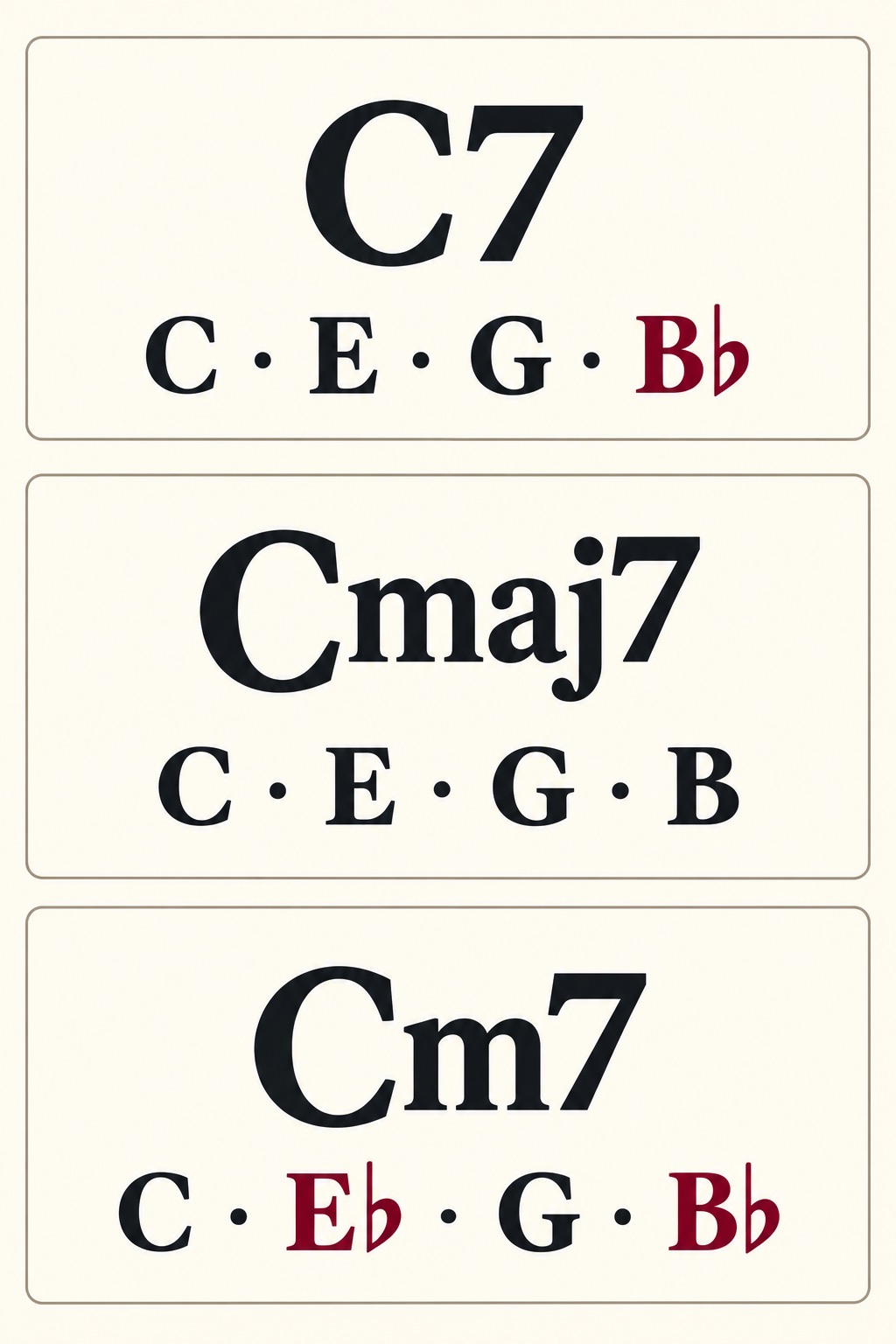
Play the three chords in turn, keeping C and G where they are. First lower B to B♭; then lower E to E♭ as well. You can hear what each change does without memorising three unrelated shapes. Berklee’s guide to lead sheets and chord symbols also distinguishes 7 from maj7.
What do “sus”, “add9” and “9” change?
Csus4 replaces the third, E, with F: C–F–G. In Csus2, D takes its place: C–D–G. Sus signals that the third has been suspended or replaced. It does not simply add another note to the triad.
Cadd9 retains the third and adds D: C–E–G–D. In ordinary chord-symbol usage, C9 also implies a minor seventh: C–E–G–B♭–D. Play Cadd9 as C9 and you introduce a B♭ that the symbol never asked for. That is the distinction to check when you meet a 9 on the page.
What does the note after the slash mean?
In G/B, play a G major chord (G–B–D) with B in the bass. The slash separates the chord from its lowest note; it is neither a fraction nor a second chord. Your left hand could play B while your right hand puts G–B–D in a comfortable position.
When the bass note belongs to the chord, as it does here, the result is an inversion. Our guide to chord inversions on the piano shows how they can smooth the movement between chords. A slash can also specify a bass note outside the chord; it still tells you what should sound below, although it no longer describes a simple inversion.
From the page to the keyboard: four bars
Try this sequence, one chord per bar: | C | G/B | Am7 | Fadd9 |. There is no need to rush or fill several octaves. Say each symbol aloud first. Then prepare the bass with your left hand and keep the other notes near middle C.
| Bar | Left hand | Chord notes | What to notice |
|---|---|---|---|
| C | C | C–E–G | A letter alone indicates a major chord. |
| G/B | B | G–B–D | The bass changes; the chord remains G major. |
| Am7 | A | A–C–E–G | The “m” changes the third; the 7 adds G. |
| Fadd9 | F | F–A–C–G | G is added without removing the third, A. |
When should each chord change?
Play each chord once at the start of its bar and count four beats before moving on. Next, try a simple accompaniment: one bass note in the left hand and a gentle repeat of the chord in the right. The symbols tell you which harmony to use; the time signature, melody and style help you decide when and how to play it. If a sheet gives only chord letters, with no bars or rhythm, you will need to hear the song or find another reference to know how long each chord lasts.
Now return to our guide to chord progressions and read one of its patterns like a lead sheet: find the root first, then the chord quality, and finally a comfortable path from one hand position to the next.
If you are learning to accompany songs and choosing an instrument, tell us what you play and where you will practise. The Royal Pianos team can advise you according to your level, space and preferences, and you can try instruments in store when possible.
About this article. It was prepared by the Royal Pianos Marketing Team for the “Music Theory Applied to Piano” series. Its chord-symbol explanations and examples were checked against music-theory material from Berklee and Open Music Theory, and written so that readers can test them directly at the keyboard.
Editorial note. Chord symbols can vary between editions and styles. The examples use common conventions of international chord notation and show each chord’s basic notes; a player may spread or double them across different octaves.
Artificial Intelligence disclosure. The featured image and the seventh-chord comparison were generated with Artificial Intelligence to illustrate the content. The scene does not depict a specific piano model. The notes and musical text were reviewed editorially.











Leave a Reply
Want to join the discussion?Feel free to contribute!