

Chords are everywhere: in song accompaniments, classical works and almost every harmony exercise. Understanding how piano chords are built will help you read music more confidently, accompany melodies and, above all, recognise why certain notes work well together.
This is the first article in our series on music theory applied to the piano. We will build chords from scratch and directly on the keyboard. The good news is that you do not need to memorise endless lists: a few clear formulas will allow you to work from any starting note.
How piano chords are built: the basic structure
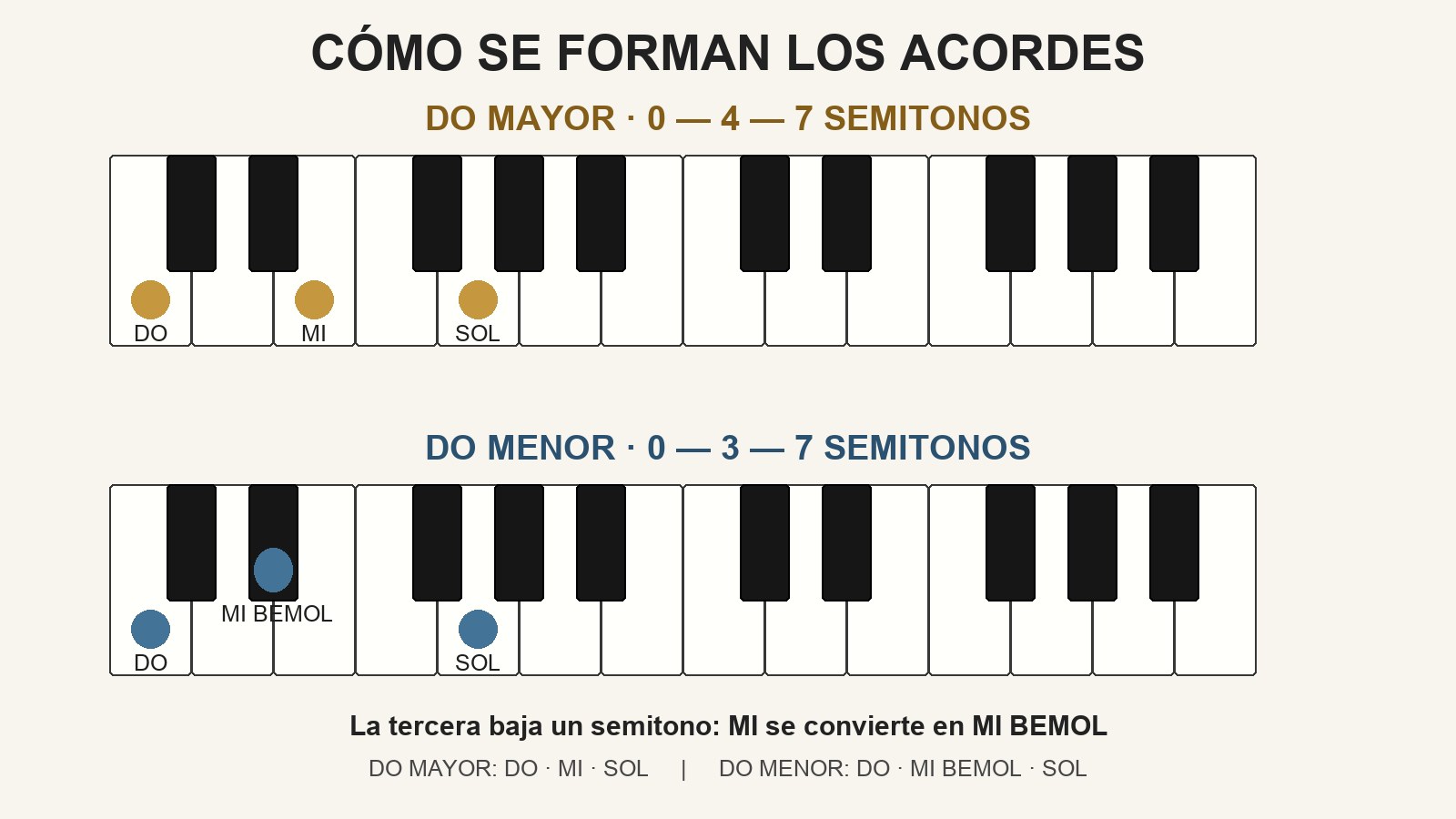
Visual comparison of the notes in C major and C minor. Image generated using Artificial Intelligence for illustrative purposes.
A chord is a group of notes that sound together or are perceived as one harmonic unit. The simplest piano chords usually contain three different notes and are called triads.
A triad consists of three elements:
- Root: the note that gives the chord its name.
- Third: the note that mainly determines whether the chord is major or minor.
- Fifth: the note that provides stability and completes the basic structure.
For example, a C major chord contains C, E and G. C is the root, E is the third and G is the fifth.
For further background, the Wikipedia article on musical triads summarises the four basic types and the function of their intervals.
Semitones, tones and intervals
To build chords, you first need to understand the distance between notes. On the keyboard, a semitone is the smallest distance between two adjacent keys, whether they are white or black. Two semitones make one whole tone.
Starting from C, the next key is C sharp, so the distance is one semitone. From C to D there are two semitones, or one whole tone.
Intervals let us measure the structure of each chord accurately. Instead of memorising every triad as a separate shape, we can learn a formula and move it to any part of the keyboard.
How to build a major chord
A major triad contains:
- The root note.
- A major third, four semitones above the root.
- A perfect fifth, seven semitones above the root.
You can also think of it as four semitones from the root to the third, followed by three semitones from the third to the fifth.
Example: C major
- Root: C.
- Major third: E.
- Perfect fifth: G.
The result is C, E and G. Play the three notes together and listen to their clear, stable character.
Example: D major
- Root: D.
- Major third: F sharp.
- Perfect fifth: A.
F must be sharp to preserve the distance of four semitones from D. If you played F natural, the chord would be minor.
How to build a minor chord
A minor triad differs from a major triad by just one note: the third is lowered by one semitone. Its structure is:
- The root note.
- A minor third, three semitones above the root.
- A perfect fifth, seven semitones above the root.
You can also count three semitones from the root to the third and four from the third to the fifth.
Example: C minor
- Root: C.
- Minor third: E flat.
- Perfect fifth: G.
The chord contains C, E flat and G. Compare it with C major. Only one key changes, yet the harmonic colour is clearly different.
Diminished and augmented chords
Besides major and minor triads, there are two other basic structures worth knowing.
Diminished triad
A diminished triad contains a minor third and a diminished fifth. Measured from the root, the notes are three and six semitones above it.
C diminished contains C, E flat and G flat. Its unstable sound creates tension that often seeks resolution in another chord.
Augmented triad
An augmented triad contains a major third and an augmented fifth. Measured from the root, the notes are four and eight semitones above it.
C augmented contains C, E and G sharp. Its open, unsettled quality is often used as a transition or expressive device.
Summary of the four basic triads
| Chord type | Formula from the root | Example from C |
|---|---|---|
| Major | 0, 4 and 7 semitones | C, E, G |
| Minor | 0, 3 and 7 semitones | C, E flat, G |
| Diminished | 0, 3 and 6 semitones | C, E flat, G flat |
| Augmented | 0, 4 and 8 semitones | C, E, G sharp |
What are chord inversions?
The notes of a chord do not always need to appear with the root at the bottom. We can change their order without changing the chord’s basic identity. These different arrangements are called inversions.
C major can be played in three main positions:
- Root position: C, E, G.
- First inversion: E, G, C.
- Second inversion: G, C, E.
Inversions make chord changes smoother because the hand can remain in the same area of the keyboard. They also help shape accompaniments and control which note appears in the lower or upper register.
How seventh chords are built
Seventh chords add a fourth note to the triad. This extra note expands the harmonic colour and can create tension, warmth or a sense of movement.
Dominant seventh chord
Add a minor seventh to a major triad. C dominant seventh, written C7, contains C, E, G and B flat.
Major seventh chord
Add a major seventh to a major triad. C major seventh, written Cmaj7, contains C, E, G and B.
Minor seventh chord
Add a minor seventh to a minor triad. C minor seventh, written Cm7, contains C, E flat, G and B flat.
Many other chords contain four or more notes, but mastering triads and inversions first makes them much easier to understand.
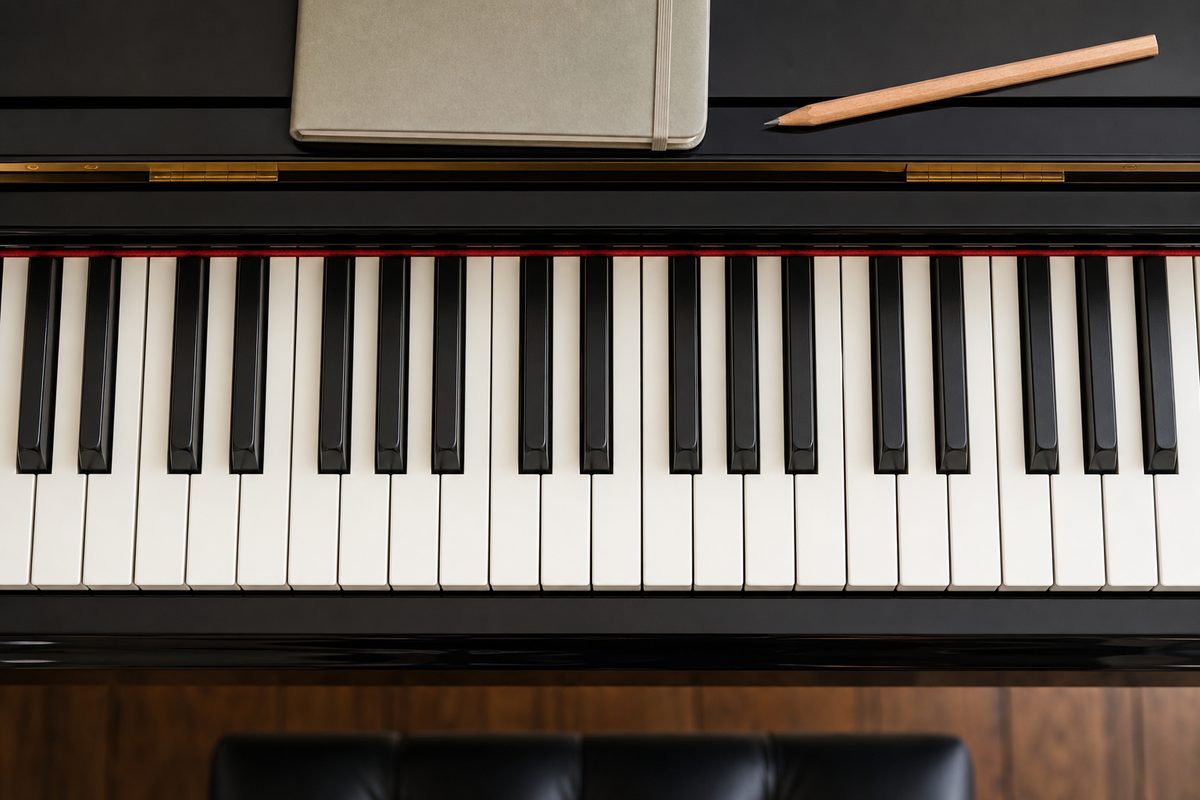
The keyboard layout helps explain intervals, triads and inversions. Image generated using Artificial Intelligence for illustrative purposes.
How to practise building piano chords
- Choose a root note.
- Build its major chord by counting semitones.
- Lower the third by one semitone to make it minor.
- Compare the sound of both chords.
- Play root position and both inversions.
- Repeat the exercise from all twelve notes.
- Practise changing chords with the smallest possible hand movement.
At first, say the notes aloud as you play them. Later, learn to recognise the shapes visually while still understanding the role of each note.
Common mistakes when learning chords
- Memorising shapes without knowing which notes they contain.
- Counting only white keys and forgetting sharps and flats.
- Playing with tension in the hand or lifting the fingers unnecessarily.
- Always practising chords in root position.
- Using too much pedal and blurring harmonic changes.
- Confusing the chord name with the note in the bass.
Frequently asked questions about piano chords
How many notes does a chord need?
Basic triads use three different notes. Chords can also contain four, five or more notes. In some contexts, two notes may suggest a harmony, although they are normally described as an interval.
How can I build piano chords without memorising every position?
Memory is useful, but understanding the formulas matters more. Once you know the structure of major, minor, diminished and augmented chords, you can build them from any note.
Why can the same chord be played in different ways?
Its notes can be reordered, doubled and spread across different octaves. As long as the essential notes remain, it belongs to the same harmonic family, although its sound and specific function may change.
Should I practise chords with both hands?
Yes. Begin with each hand separately and use comfortable fingering. Then practise with both hands and distribute the notes across different registers to hear how the balance changes.
Conclusion
Learning how piano chords are built is far more useful than memorising isolated shapes. The root, third and fifth explain the structure of triads; inversions make movement smoother, and sevenths expand the harmonic language.
Try every example on your instrument and listen carefully to the differences. Theory becomes truly useful when you connect the formula with the sound and the physical feeling of the keyboard.
If you are learning piano and looking for an instrument suited to your level, space and practice routine, explore our selection of digital pianos and upright acoustic pianos. You can also contact Royal Pianos for personalised advice or to arrange an in-store trial.
The images in this article were generated using Artificial Intelligence for illustrative purposes. They do not necessarily represent real instrument models, finishes or configurations.











Leave a Reply
Want to join the discussion?Feel free to contribute!