

The circle of fifths for pianists is a map of the twelve keys. It shows how many sharps or flats belong to a key signature, where to find its relative minor and which chords are closely related.
Its value is not in memorising a diagram. It becomes useful when those relationships are brought to the keyboard: while reading, accompanying, composing or changing key with a clearer sense of direction.
Why does it look complicated when it only organises twelve keys?
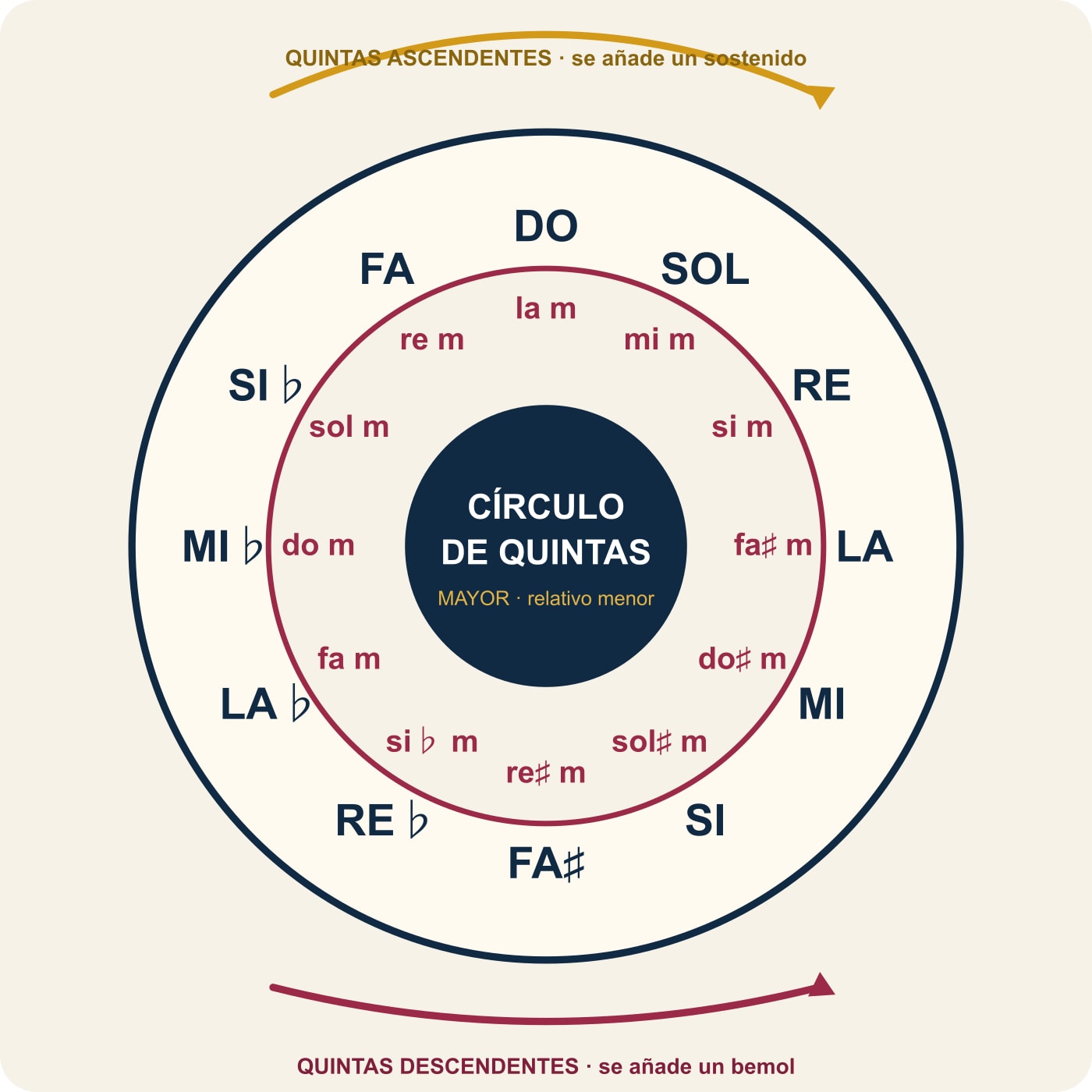
At the top sits C major, with no sharps or flats. Moving clockwise, each step rises by a perfect fifth: C–G, G–D, D–A. Each new key adds one sharp to its signature.
In the opposite direction, the path moves by descending fifths — or ascending fourths — and one flat is added at each step.
The circle brings several ideas together in one image. It orders key signatures, shows how close keys are to one another and places each major key beside its relative minor. It is easy to confuse these jobs when the circle is treated as a decorative wheel. Read one layer at a time.
Circle of fifths for pianists infographic. Image generated by Artificial Intelligence to illustrate the content.
How can I tell how many sharps or flats a key has?
Starting from C major, the clockwise route begins with G major, which has F sharp. D major keeps that F sharp and adds C sharp. A major adds G sharp. The order never changes: F, C, G, D, A, E, B.
In the flat direction, F major has B flat; B flat major adds E flat; E flat major adds A flat. Their order is equally fixed: B, E, A, D, G, C, F. Seeing this pattern on the keyboard makes it clear that each neighbouring key changes only one note.
Open Music Theory’s explanation of major scales and key signatures develops the connection between fifths, accidentals and keys in more detail.
Why do neighbouring keys sound so close?
C major and G major share six of their seven notes; only F changes to F sharp. C major and F major also share six notes, with B flat as the only difference. That resemblance is why moves to neighbouring keys often feel so natural.
You can hear it without opening a score. Play a short phrase in C major, then repeat it with F changed to F sharp and G as the new point of rest. The colour has shifted, yet the material still feels familiar.
How do I find the relative minor without counting keys?
Every major key shares its signature with a minor key. C major and A minor have no accidentals; G major and E minor share F sharp; F major and D minor share B flat. In the usual circle, the relative minor appears on an inner ring, aligned with its major partner.
Sharing notes does not mean sharing the same tonal centre. A melody in C major tends to rest on C; in A minor, the pull moves towards A. Listen for where a phrase settles and notice which chords carry the greatest weight.
Can the circle tell me which chords belong to a key?
The circle does not replace chord construction, but it helps us find our bearings quickly. In C major, the main chords C, F and G sit together: the tonic is at the centre of the relationship and its neighbours provide the subdominant and dominant. Their close relative minors complete much of the diatonic vocabulary.
A progression such as C–G–A minor–F can be moved to G major while keeping its scale degrees: G–D–E minor–C. The diagram does not write the progression for us; it shows which relationships remain when the key changes.
If you need a refresher on triads, read our guide to how chords are built on the piano. The article on major scales on the keyboard is also useful for understanding where the accidentals come from.
What can I do with the circle during a practice session?
Read a key signature before you play
Find the key, identify its accidentals and play the scale slowly. Then try the I, IV and V chords. That minute of preparation gives both hand and ear a context before you begin the piece.
Transpose an accompaniment
Write down the degrees of a progression instead of clinging to chord names. Choose another key on the circle, then rebuild the same degrees. It is a practical way to adapt a song to a different voice without relying on a written transposition.
Look for a nearby change of key
If a piece stays in one colour for too long, try a neighbouring key. Because the two keys share six notes, the connection can be made with very little movement. Listen first; the circle suggests possibilities, not a harmonic obligation.
A fifteen-minute exercise
- Start in C major and play its scale and I, IV and V chords.
- Move one step clockwise and repeat in G major.
- Continue to D major, noticing which sharp has been added.
- Return to C and travel the other way through F and B flat major.
- Finish by playing each major key followed by its relative minor.
You do not need to complete the entire wheel in one session. Two or three keys heard properly teach more than a mechanical lap. The aim is to connect the name, the signature, the keyboard shape and the sound.
Errors that make the circle unhelpful
The first is memorising positions without playing. The second is assuming that adjacent chords automatically make a good song.
It is also worth avoiding the idea that enharmonic keys are interchangeable in every context. F sharp major and G flat major may sound the same on an equal-tempered piano, but their written signatures and their notated function are not the same.
Used at the keyboard, the circle stops being a chart and becomes a way of anticipating relationships. Choose a key, listen to its neighbours and then test the theory in a real piece.
Would you like to practise these relationships on an instrument that responds to every nuance? Explore Royal Pianos’ selection of digital pianos or contact the team for guidance based on your level, room and way of practising.
The images included in this article were generated using Artificial Intelligence to illustrate the content. They do not necessarily represent actual instrument models, finishes or configurations.











Leave a Reply
Want to join the discussion?Feel free to contribute!