

When studying minor scales on the piano, one question inevitably appears: why are there three different forms? The natural, harmonic and melodic minor scales are not three independent keys. They are three ways of organising particular scale degrees within the same minor key to meet different harmonic and melodic needs.
Understanding this relationship prevents us from memorising lists without context. We will use A minor as our main example because its natural form contains no sharps or flats. We will then explore which notes change, what effect they create and how to practise each version clearly and musically.
What the three minor scales have in common
All three forms share the tonic and, most importantly, the minor third. This minor third is one of the features that distinguishes the minor colour from the major. The differences appear in the sixth and seventh scale degrees:
- The natural minor keeps the sixth and seventh degrees lowered in relation to the parallel major scale.
- The harmonic minor raises the seventh degree to create a leading note that moves towards the tonic.
- The melodic minor, in its traditional classical ascending form, raises the sixth and seventh degrees; when descending, it returns to the natural minor form.
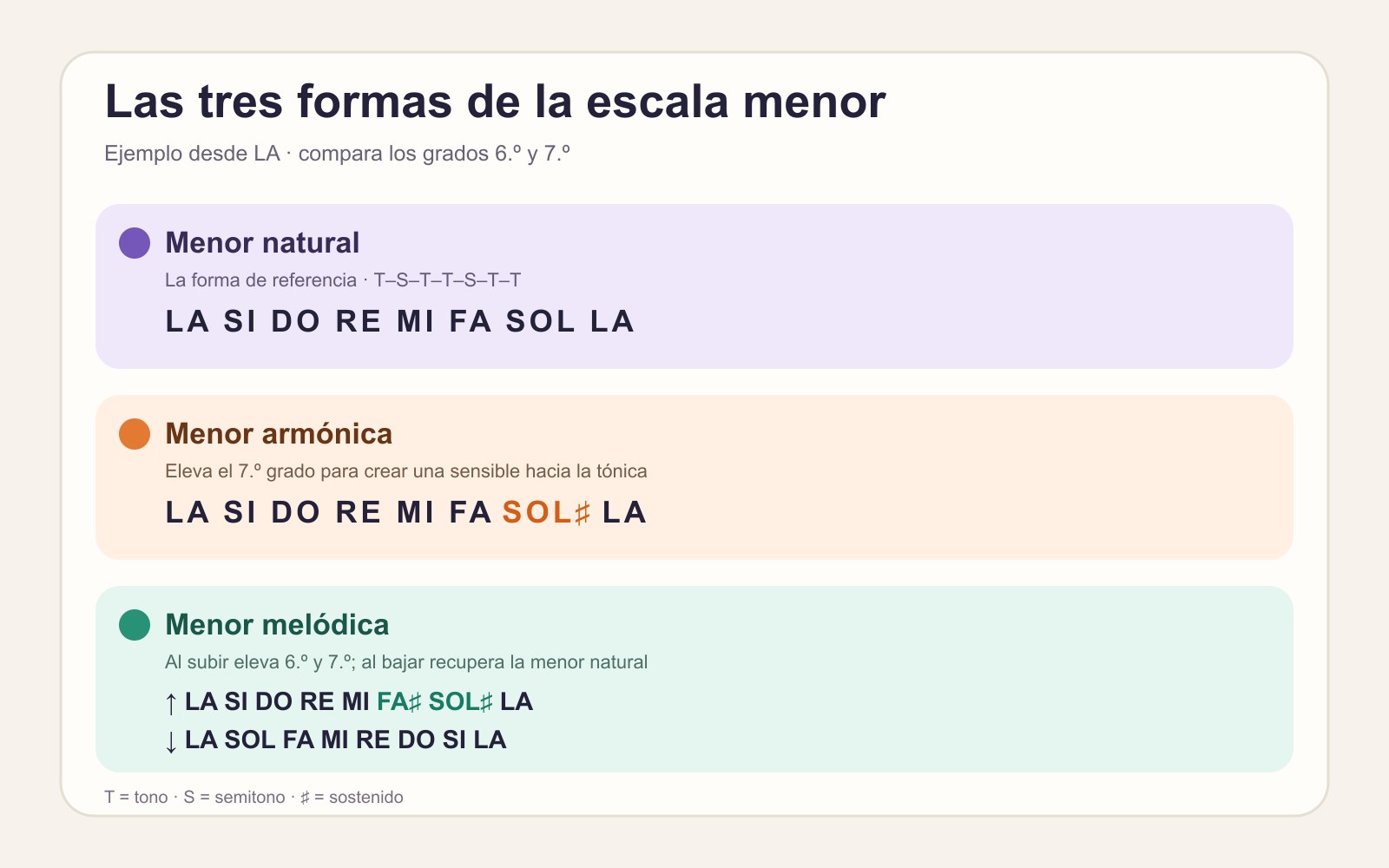
The three forms share the same tonic and differ mainly in their sixth and seventh degrees. Image generated by Artificial Intelligence to illustrate the content.
The comparison shows that these are not three separate worlds. We can begin with the natural minor scale and change one or two notes to obtain the other forms.
The natural minor scale
The natural minor scale follows this sequence of intervals:
tone – semitone – tone – tone – semitone – tone – tone
Starting on A, we obtain:
A – B – C – D – E – F – G – A
Because it uses only white keys, it is the most comfortable starting point. It is also the relative minor of C major: the two keys share the same notes and key signature, but they are organised around different tonics. Music in A minor tends to feel A as its point of rest, whereas C is the centre in C major.
The natural form is useful for understanding a minor key signature, creating modal melodies and recognising the scale’s basic colour. Its seventh degree, however, lies a whole tone below the tonic. This distance does not produce the same pull towards the final note that we hear in a major scale.
The harmonic minor scale and the pull of the leading note
To strengthen the arrival on the tonic, the harmonic minor scale raises the seventh degree by a semitone. In A minor, G becomes G sharp:
A – B – C – D – E – F – G♯ – A
G sharp is now a semitone below A and acts as a leading note. The ear hears a clear tension that asks to resolve to the tonic. This alteration also changes the harmony: the chord on the fifth degree becomes E major —or E seventh— instead of E minor, greatly strengthening the dominant-to-tonic movement.
An augmented second appears between F and G sharp, equal to three semitones. It is an expressive and immediately recognisable interval. It is neither a mistake nor a distance that must be avoided: it is part of the harmonic minor scale’s character, although it can be less comfortable to sing or to use in certain melodic lines.
The melodic minor scale: a solution for the musical line
The melodic minor scale smooths this augmented-second leap by also raising the sixth degree on the way up. In ascending A melodic minor, F becomes F sharp and G becomes G sharp:
Ascending: A – B – C – D – E – F♯ – G♯ – A
In classical practice, the need to lead towards the tonic disappears when the melody descends. The natural degrees therefore return:
Descending: A – G – F – E – D – C – B – A
The ascending result creates a smoother path through E, F sharp, G sharp and A. It is worth listening to the difference rather than merely remembering that the scale “goes up one way and comes down another”. The musical reason lies in the direction of the phrase and in the function of each note.
In jazz and some modern music, “melodic minor” usually means the ascending form used in both directions. It is therefore important to pay attention to the musical context and the style being studied.
How to build the three forms from any note
- Build the natural minor scale. Apply T–S–T–T–S–T–T from the tonic.
- Locate the sixth and seventh degrees. These are the notes that will change.
- For harmonic minor, raise only the seventh degree by a semitone.
- For ascending melodic minor, raise the sixth and seventh degrees.
- For traditional descending melodic minor, use the natural form.
For example, D natural minor contains D, E, F, G, A, B flat, C and D. Harmonic minor raises C to C sharp. Ascending melodic minor raises B flat to B natural and C to C sharp; on the way down, it returns to B flat and C natural.
To explore these rules in more depth, see the reliable Music Theory for the 21st-Century Classroom chapter on minor scales, which compares their scale degrees and the direction of melodic minor.
Fingering and movement at the piano
In A minor, the basic one-octave fingering is the same as in C major. The ascending right hand uses 1–2–3, thumb under, 1–2–3–4–5. The left hand ascends 5–4–3–2–1, passes the third finger over and finishes 3–2–1.
All three forms can keep this fingering because the altered notes occupy the same scale degrees. The physical sensation nevertheless changes when F sharp and G sharp are introduced. Practise the contact with the black keys slowly and avoid pushing the whole hand abruptly towards the back of the keyboard.
Fingering can vary in other keys. The important thing is to choose a coherent pattern, write it down if necessary and repeat it consistently. Speed should come after control and regularity.
Comparing the three forms slowly allows us to hear what changes before increasing the speed. Image generated by Artificial Intelligence to illustrate the content.
A practical routine for recognising and playing them
A short session can combine understanding, listening and technique:
- Play A natural minor and pause on the sixth and seventh degrees: F and G.
- Repeat the harmonic form, noticing G sharp and its pull towards A.
- Play melodic minor very slowly: F sharp and G sharp ascending; F and G natural descending.
- Alternate the three forms without stopping and say the changing notes aloud.
- Finish by playing A minor, D minor, E major and A minor chords to hear the harmonic function of G sharp.
The metronome is a tool for checking regularity, not forcing speed. Begin with one beat per note and keep the dynamics even. When the movement feels comfortable, try dotted rhythms, legato articulation and several octaves.
Common mistakes when studying minor scales
Confusing the key signature with temporary accidentals
The key signature normally corresponds to the natural minor scale. The raised degrees of harmonic and melodic minor usually appear as accidentals within the music.
Always playing melodic minor in the same form both ways
In the classical tradition, the descending form returns to natural minor. In jazz, the ascending form is commonly kept in both directions. Both practices exist, but they belong to different contexts.
Treating scales only as a finger exercise
If we do not listen to the leading note, the augmented second or the change in the sixth degree, we miss the musical reason for each form. Singing the notes, playing short phrases and connecting the scale to its chords makes practice far more meaningful.
How minor scales relate to chords
Minor scales explain why music in a minor key does not always use one fixed set of chords. The natural form provides the basic material; harmonic minor creates a major dominant with a strong resolution; and melodic minor supports particular ascending lines while opening other harmonic possibilities.
To review how triads are constructed and understand this relationship more clearly, read our guide to how chords are built on the piano.
A responsive keyboard helps us develop an even tone and controlled dynamics. Explore our digital pianos and upright pianos, or contact us if you would like help choosing an instrument for your studies.
Three forms, one minor key
Natural minor presents the basic material; harmonic minor raises the seventh degree to strengthen the resolution; and melodic minor raises the sixth and seventh on the way up to create a smoother line. We do not need to choose one correct version and discard the others: each form answers a musical need.
Begin by comparing them from A, then apply the same reasoning to D, E or G minor. Once you can hear which degrees change and understand why they do so, minor scales stop feeling like three isolated formulas and become expressive musical tools.
The images included in this article were generated using Artificial Intelligence to illustrate the content. They do not necessarily represent real instrument models, finishes or configurations.









Leave a Reply
Want to join the discussion?Feel free to contribute!