

Scales appear very early in most piano courses, but the reason behind their notes is not always explained. Once we understand how major scales are built on the piano, they stop being a sequence to memorise and become a useful map for moving around the keyboard, understanding keys and playing with greater confidence.
The good news is that every major scale follows the same formula. What changes is the note on which we begin and, as a result, the black keys that we need to use. In this guide, we will explore that structure step by step, look at several examples and find a practical way to study scales without turning the exercise into a race.
How major scales are built on the piano: the basic structure
A major scale contains seven different notes and repeats the first note an octave higher to complete the journey. Two types of distance alternate between those notes:
- Tone (whole step): equal to two semitones.
- Semitone (half step): the smallest distance in the Western musical system. On the piano, it is the distance between two adjacent keys, whether they are white or black.
The formula for every major scale is always the same:
tone – tone – semitone – tone – tone – tone – semitone
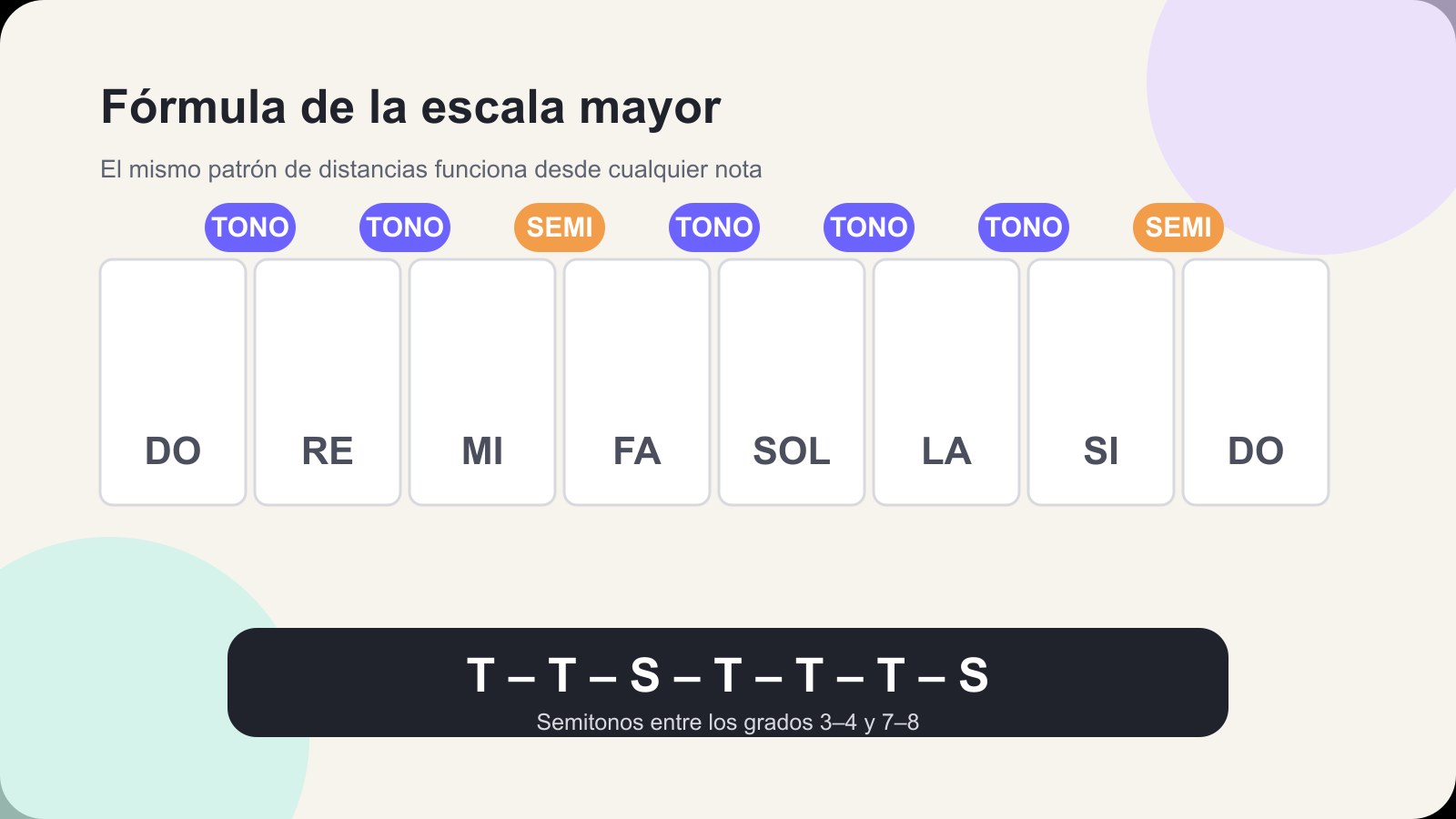
The major scale always follows the T–T–S–T–T–T–S pattern. Image generated by Artificial Intelligence to illustrate the content.
This sequence is our template. If we follow it from any starting note, we obtain that note’s major scale. It is also worth remembering that each letter name must appear once: C, D, E, F, G, A and B, although some notes will need a sharp or a flat.
The simplest example: C major
C major is the ideal starting point because it uses only white keys:
C – D – E – F – G – A – B – C
If we examine the distances, we find tones between C–D and D–E; a semitone between E–F; tones between F–G, G–A and A–B; and a final semitone between B–C. This is why we should not assume that every pair of neighbouring white keys is separated by the same distance.
On the keyboard, E–F and B–C are the two places where there is no black key between the white keys. This visual reference is helpful at first, although the important goal is to hear and recognise the distribution of the intervals.
What happens when we start on another note?
If we begin on G and play only white keys, the final distance does not fit the major-scale formula. We need F sharp to correct it:
G major: G – A – B – C – D – E – F♯ – G
The D major scale requires two sharps:
D major: D – E – F♯ – G – A – B – C♯ – D
F major contains one flat:
F major: F – G – A – B♭ – C – D – E – F
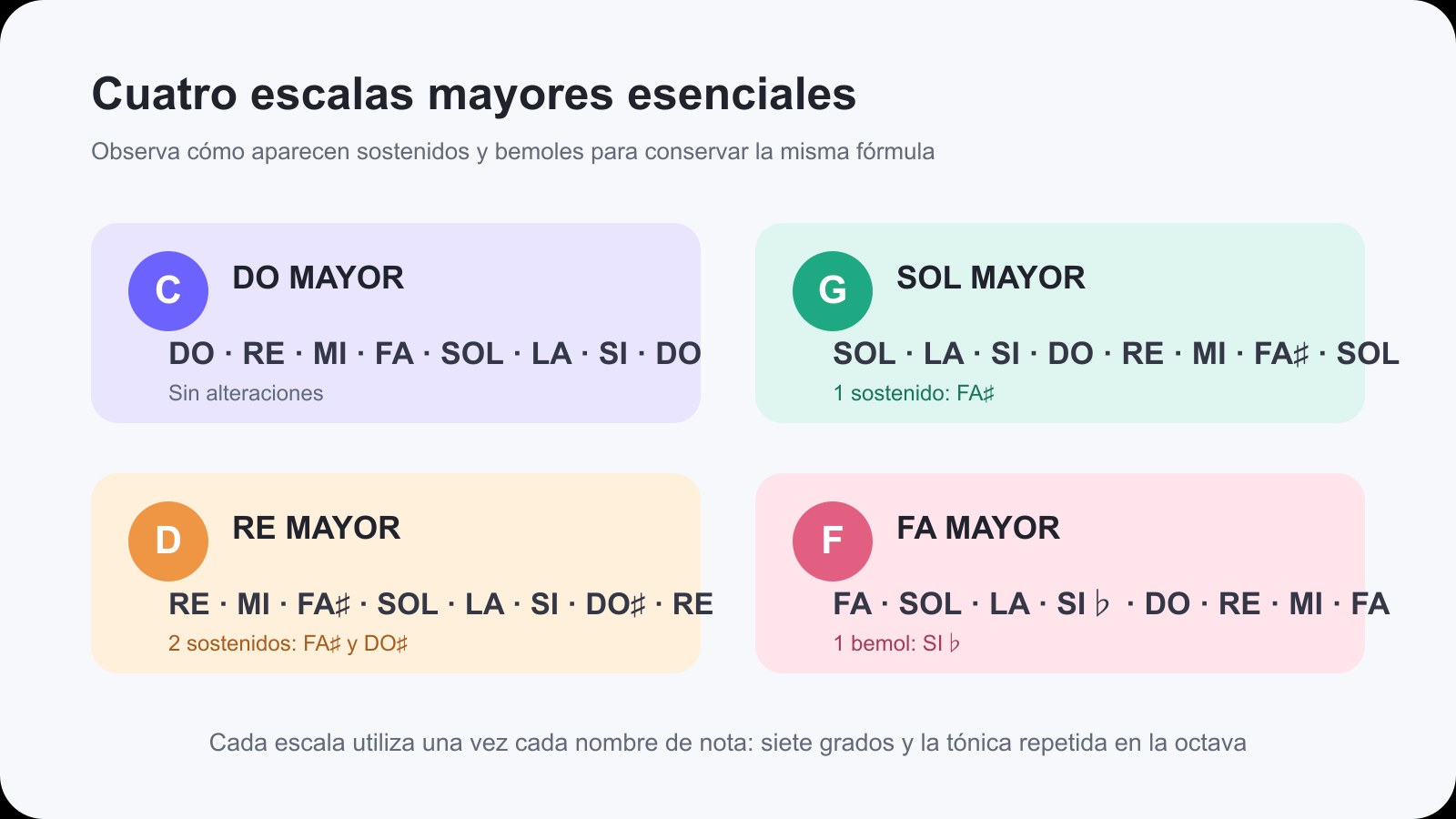
C, G, D and F major show how sharps and flats preserve the same formula. Image generated by Artificial Intelligence to illustrate the content.
Sharps and flats are not arbitrary additions: they preserve the tone and semitone pattern. To check the formula and explore the theory in greater depth, you can consult this reliable Open Music Theory resource on scales.
How to build a major scale from any key
- Choose the tonic. This is the note that names the scale and acts as its point of rest.
- Apply the formula. Move T–T–S–T–T–T–S, counting every adjacent piano key.
- Check the note names. Each musical letter should appear once before the tonic is repeated.
- Play and listen. The final note should feel like a stable arrival, not merely the mechanical end of the exercise.
A common mistake is to count only the white keys. To measure a semitone, look at the next physical key, regardless of its colour. Another frequent mistake is to write the same letter name twice when its enharmonic equivalent would be correct. At the beginning, it is useful to work with C, G, D and F major before approaching keys with more accidentals.
Fingering: a practical route across the keyboard
Understanding the notes is only part of the work. Fingering organises the movement of the fingers so that the hand does not run out of room. The ascending C major scale is normally played in the right hand as 1–2–3, thumb under, 1–2–3–4–5. In the left hand, the usual ascending pattern is 5–4–3–2–1, third finger over, 3–2–1.
The numbers represent the thumb (1), index finger (2), middle finger (3), ring finger (4) and little finger (5). Not every scale uses exactly the same fingering, particularly when several black keys are involved. It is therefore helpful to learn a stable fingering for each scale instead of improvising a different sequence of fingers every time.
The thumb movement should feel small and relaxed. There is no need to twist the wrist abruptly or lift the fingers excessively. Good fingering should support continuity, comfort and an even tone.
Practising with a metronome helps us control pulse, coordination and tone. Image generated by Artificial Intelligence to illustrate the content.
A short routine for practising major scales
You do not need to study every key in a single session. A focused ten-minute routine can be more effective:
- Play one scale slowly with the right hand and then with the left.
- Say the note names aloud and identify where the semitones occur.
- Repeat with a metronome at a comfortable speed, without rushing the thumb movement.
- Combine both hands only when each hand can play continuously on its own.
- Finish by playing a melody, a chord or a short improvisation in that key.
This approach connects theory with real music. Scales help us recognise patterns in scores, anticipate accidentals and understand chords more clearly. To continue exploring that relationship, read our guide to how chords are built on the piano.
How to develop an even sound
A scale is not well played simply because the notes are correct. Listen for an even volume, a steady pulse and a hand that remains free from tension. Begin slowly and increase the speed only when the movement feels natural.
You can also vary your practice: play legato and then detached, use long–short rhythmic patterns, change the dynamics or extend the scale across several octaves. These variations keep the mind engaged and reveal weak points that can go unnoticed when we repeat the same version every time.
The instrument also affects control. A responsive keyboard lets you work on subtle changes of touch and dynamics. Explore our selection of digital pianos and upright pianos, or contact us if you would like personal guidance.
Frequently asked questions about major scales
How many major scales are there?
In practice, musicians study twelve tonal centres, one for each note of the chromatic octave. Some keys can be written in more than one enharmonic form, using either sharps or flats.
Do I need to memorise every accidental?
It is useful to recognise them eventually, but understanding the formula matters more at the beginning. Building several scales by reasoning through the intervals makes their key signatures easier to remember later.
Should I practise scales every day?
Regular practice helps, provided that each session has a clear purpose. Five or ten attentive minutes are usually more valuable than many fast, tense repetitions.
Why does a major scale sound “happy”?
The major mode is often associated with a bright character, but that impression also depends on rhythm, register, harmony, interpretation and musical context. A scale alone does not determine the complete emotion of a piece.
From the formula to real music
Understanding how major scales are built on the piano gives our practice a clear purpose. The T–T–S–T–T–T–S formula explains why each key uses particular notes and provides a solid basis for studying melodies, chords, sight-reading and improvisation.
Begin with C major, then add G, F and D, always listening to the result. When the mind understands the pattern and the hand learns a comfortable movement, the scale stops being an isolated exercise and becomes part of the musical language.
The images included in this article were generated using Artificial Intelligence to illustrate the content. They do not necessarily represent real instrument models, finishes or configurations.











Leave a Reply
Want to join the discussion?Feel free to contribute!