

Musical intervals on the piano are the distance between two notes, whether they sound one after the other or are played together. Learning to measure and recognise them makes reading easier, reveals how chords and scales are built, clarifies the movement of a melody and provides a route into playing by ear. This guide explains how intervals are counted on the keyboard, why the same number can have different qualities and which exercises help us hear them without turning practice into a memory test.
What exactly is a musical interval?
When a melody moves from C to E, we hear a leap. When C and E are played together, we hear a combination of two pitches. In both cases there is a relationship between the notes: that relationship is the interval.
The word “distance” can make us think only of centimetres or the number of keys. Music uses two measurements. First, we count note names to find the interval number; then we examine tones and semitones to determine its quality. C–E and C–E flat are therefore both thirds, although they neither sound the same nor cover exactly the same chromatic distance.
This double reading is one reason the piano is so useful for studying music theory. The sequence of keys makes every semitone visible and allows us to check immediately what we hear.
How do you count an interval on the keyboard?
The number is found by counting notes inclusively: both the starting note and the destination are included. From C to D we count C–D, a second. From C to E, C–D–E, a third. From C to G, C–D–E–F–G, a fifth.
This method avoids a common mistake: counting only the keys in between. The interval name does not describe how many spaces we cross. It tells us how many scale degrees are spanned from the first note to the second.
- C–C: unison or first.
- C–D: second.
- C–E: third.
- C–F: fourth.
- C–G: fifth.
- C–A: sixth.
- C–B: seventh.
- C–C above: octave.
Accidentals do not change that number. C–E, C–E flat and C sharp–E still span the letters C, D and E, so all three are thirds. Their quality is what changes.
What do major, minor, perfect, augmented and diminished mean?
Once we know the number, we measure the precise distance in semitones. On the piano, a semitone is the step between two adjacent keys, regardless of colour. This second measurement tells us whether an interval is major, minor, perfect, augmented or diminished.
Seconds, thirds, sixths and sevenths can be major or minor. Unisons, fourths, fifths and octaves belong to the family of perfect intervals. Expanding a major or perfect interval by one semitone produces an augmented interval; reducing a minor or perfect interval by one semitone produces a diminished one.
A few examples make the terminology clearer:
- C–E flat: minor third, three semitones.
- C–E: major third, four semitones.
- C–F: perfect fourth, five semitones.
- C–G: perfect fifth, seven semitones.
- C–B: major seventh, eleven semitones.
- C–C above: perfect octave, twelve semitones.
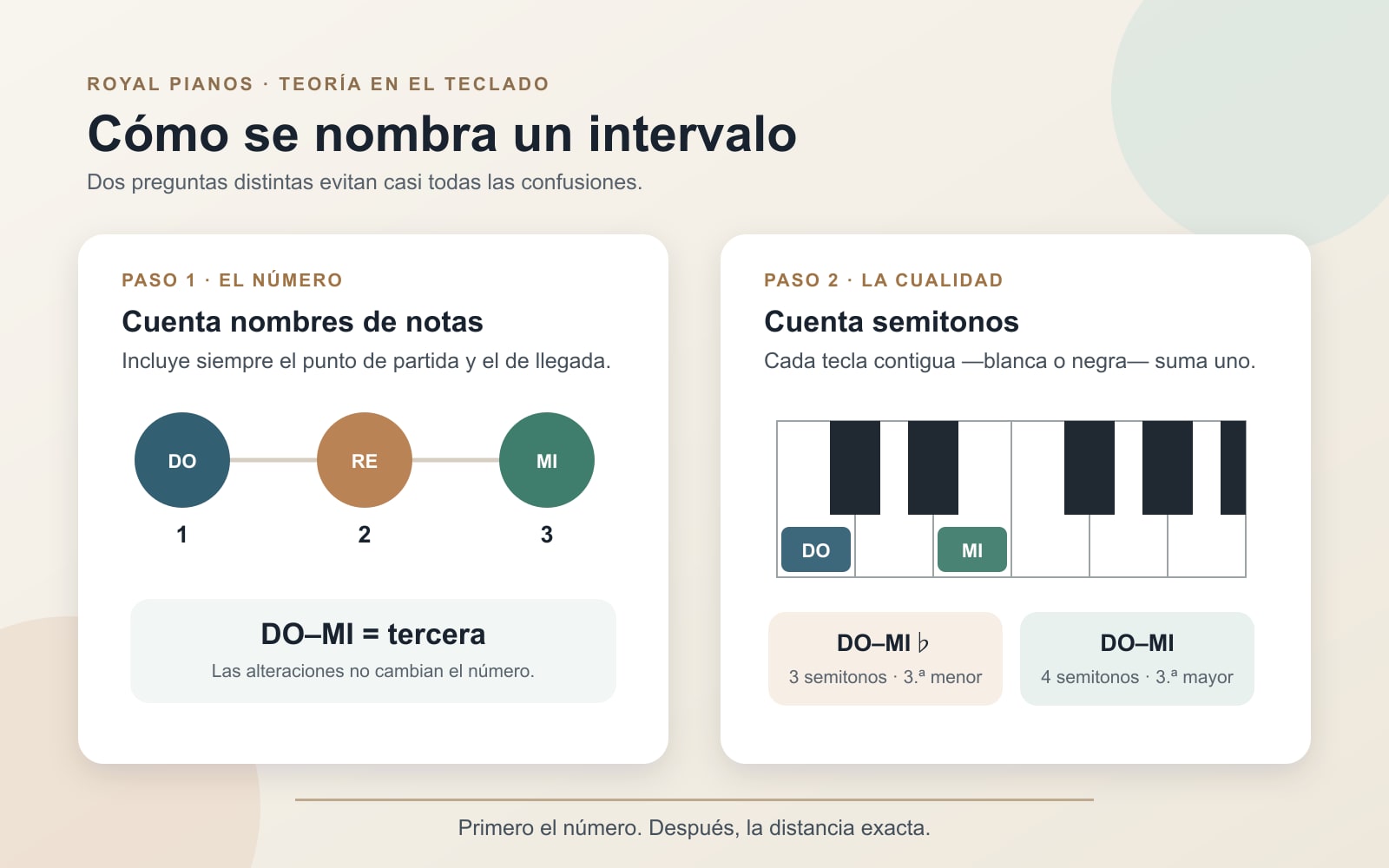
First count the note names; then use the semitones to determine the quality. Image generated by Artificial Intelligence to illustrate the content.
It helps to keep two questions separate: “How many note names does it span?” and “How many semitones does it contain?” Finding the number first and the quality second is more reliable than trying to guess the full name at a glance.
Are melodic and harmonic intervals the same?
The notes of a melodic interval sound successively. This is what happens in most melodic movement: one note leads to the next. In a harmonic interval, both notes sound at the same time. The keys may be identical, but the listening experience changes.
Pianists benefit from practising both forms. Playing C and then G helps us hear the direction and width of the leap; pressing them together reveals the stability and colour of the fifth. This difference also explains why recognising an interval within a song can be more demanding than identifying two isolated notes.
Why can two intervals with the same number of semitones have different names?
On an equal-tempered piano, F sharp and G flat use the same key and have the same pitch. Nevertheless, C–F sharp is an augmented fourth, while C–G flat is a diminished fifth. Both contain six semitones, but their spelling and musical function are not equivalent.
Musical spelling tells us how a note behaves within a scale, chord or phrase. It is not a bureaucratic detail of notation. A note may lead towards another, act as a leading note or belong to a particular harmony; the interval name preserves that information.
The Open Music Theory guide to intervals develops this distinction and also explains compound intervals and inversion.
How can you recognise intervals by ear without depending on tricks?
Associating every interval with the opening of a familiar song can be a useful first reference, but it has limits. A major third does not always retain the same effect when register, direction, timbre or harmonic context changes. The aim is not to recognise a hidden tune; it is to become familiar with the relationship between the two notes.
Training works best when voice, keyboard and attention are combined:
- Play a comfortable note and sing it before continuing.
- Play the second note and listen for whether the movement rises or falls.
- Sing both notes without the piano, then check the tuning.
- Repeat the interval from different notes so that you do not memorise one fixed pitch.
- Alternate between melodic and harmonic presentation.
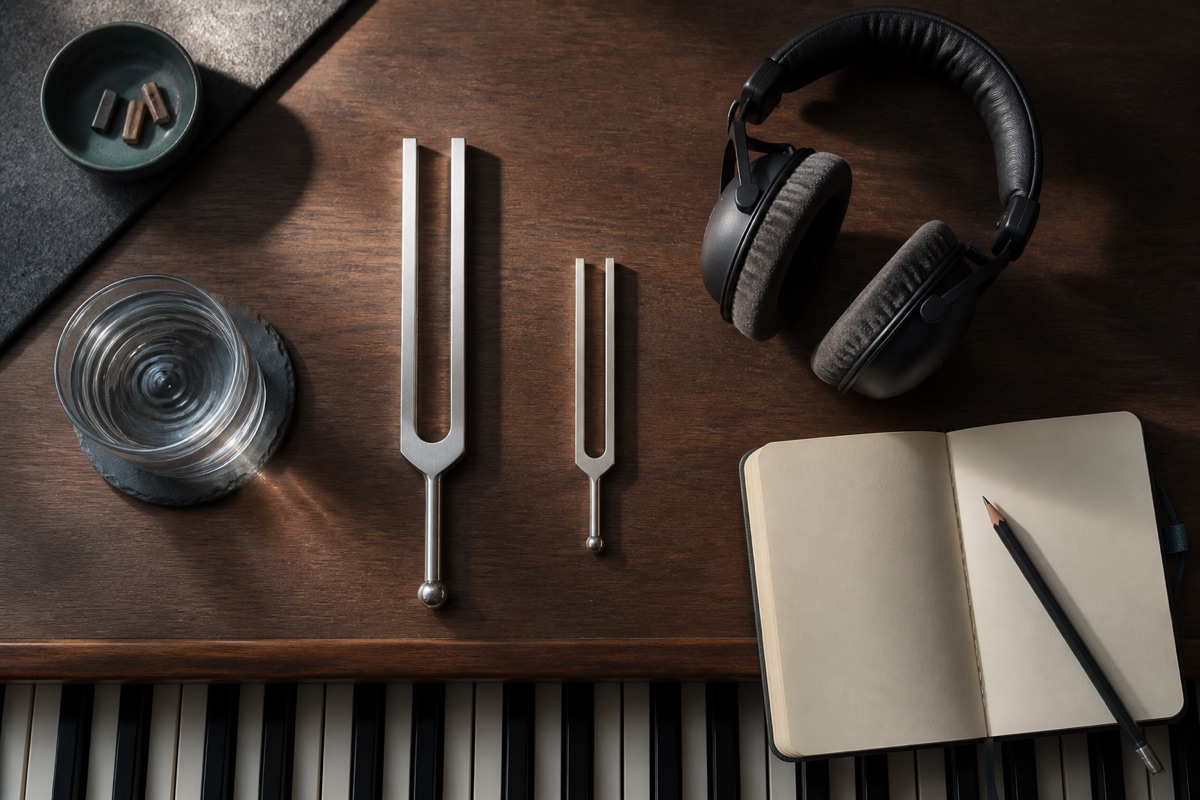
Comparing pitches from different starting notes helps to develop relative pitch. Image generated by Artificial Intelligence to illustrate the content.
At first, comparing two possibilities is more effective than confronting every interval at once. Try a major third against a minor third, followed by a fourth against a fifth. Contrast makes audible what a definition alone cannot teach.
A ten-minute routine for beginning to recognise intervals
Interval recognition improves through short, frequent sessions. This routine can become part of a daily warm-up:
- Two minutes of reading: choose five pairs of notes in a score and name only their number.
- Two minutes at the keyboard: build thirds, fourths and fifths from different keys.
- Two minutes of comparison: alternate major and minor thirds, followed by perfect fourths and fifths.
- Two minutes of singing: play the first note, sing the second and check the result.
- Two minutes of real music: find two or three leaps in a piece you are already studying.
There is no need to answer quickly. First, listen accurately; then give the sensation a name; finally, recognise it inside a piece. Speed emerges after that process has been repeated well.
What are intervals useful for when playing the piano?
Recognising intervals reduces the amount of information we need to process. Rather than reading every note as an isolated fact, we begin to see directions, steps, leaps and shapes. This improves sight-reading and helps the hand anticipate its next position.
Intervals also form the internal structure of chords. A major triad contains a major third and perfect fifth above its root; a minor triad replaces that third with a minor one. You can see this directly on the keyboard in our guide to how chords are built on the piano.
Scales can be understood in the same way. They are not simply lists of notes, but patterns of tones and semitones. This relationship is explored in our articles on how major scales are built and the three forms of the minor scale.
Common mistakes when learning intervals
Counting keys instead of note names
The number comes from the letter names, with both ends included. Semitones are used afterwards to establish the quality.
Learning only a table of semitones
The table is useful for checking an answer, but it does not explain spelling. Six semitones can form an augmented fourth or a diminished fifth, depending on the notes used.
Always practising from C
C is a convenient visual reference, but it can become a crutch. Once an example is understood, move it to F sharp, B flat or any other note.
Confusing recognition with memorising a song
Musical associations are an initial aid. Flexible hearing requires us to vary the starting note, direction and form of presentation.
Questions pianists often ask about intervals
Do I need absolute pitch to recognise them?
No. Interval recognition is a relative-pitch skill: it means hearing the relationship between two sounds even when we cannot name their exact pitch. It can be trained.
Which intervals should I learn first?
The semitone, tone, major and minor thirds, perfect fourth, perfect fifth and octave provide a practical foundation. Mastering a few contrasts in several keys is more useful than adding many names too quickly.
Do major intervals sound happy and minor intervals sad?
Not automatically. Some intervals contribute to colours we associate with major or minor, but their effect depends on register, rhythm, harmony, dynamics and what happens before and after them. Listening outside a context is useful for study; understanding intervals within music is the real goal.
From the keyboard to the ear
An interval has a written name, a visible shape on the keyboard and a sound. Studying all three dimensions together allows us to move from laboriously counting notes to recognising musical relationships. Begin with simple examples, compare them from different pitches and bring them into the repertoire you already play as soon as possible.
A responsive keyboard helps us control the attack and hear each relationship clearly. If you are choosing an instrument for study, explore our digital pianos and upright pianos, or ask the Royal Pianos team for advice.
The images in this article were generated using Artificial Intelligence to illustrate the content. They do not necessarily represent real instrument models, finishes or configurations.











Leave a Reply
Want to join the discussion?Feel free to contribute!